
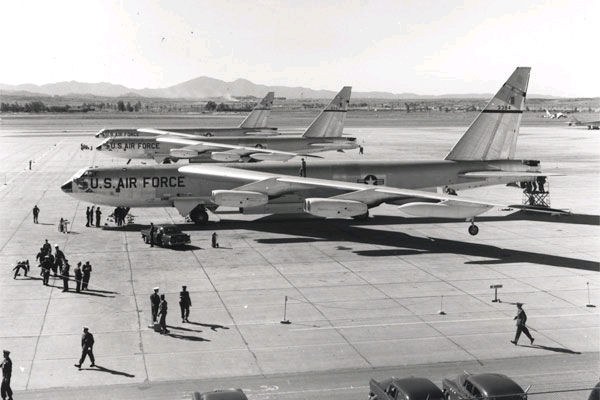
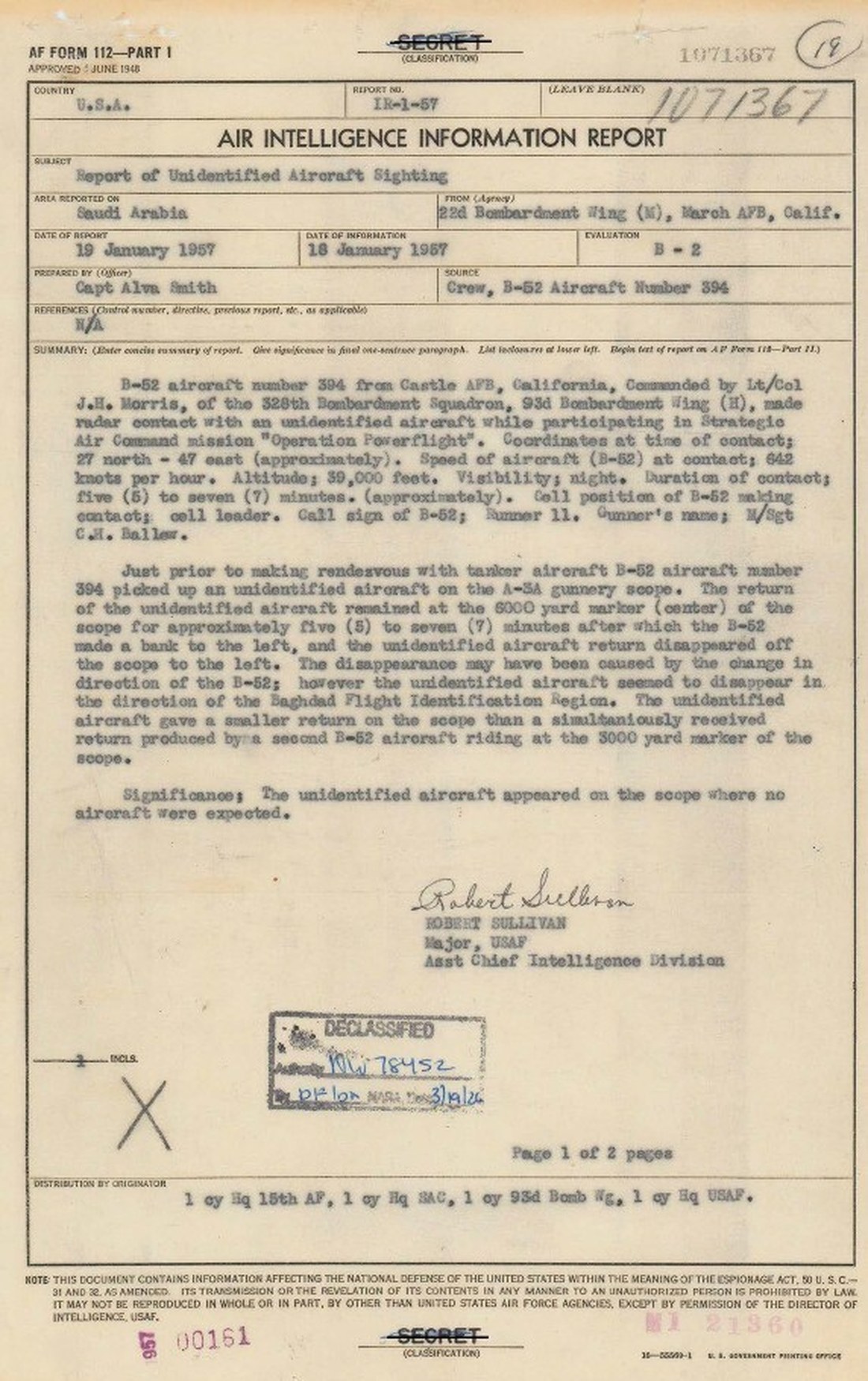
The document is two pages long, typed, and stamped SECRET. It is an Air Force Form 112, an Air Intelligence Information Report, numbered IR 18-1-57, and its subject line reads, in full: “Report of Unidentified Aircraft Sighting.” The Pentagon published it on Friday as document DOW-UAP-D155 in the seventh release of the PURSUE archive, where the department listed it among the release’s featured records. The aircraft that made the report was B-52 number 394 — the lead bomber, the cell leader, on a flight the whole Air Force was watching.
The Most Tracked Flight In The World That Week
The mission was Operation Power Flite, Strategic Air Command’s demonstration that it could deliver a hydrogen bomb anywhere on earth. At 1:00 p.m. on January 16, 1957, five B-52B Stratofortresses of the 93rd Bombardment Wing took off from Castle Air Force Base in California and headed east. Three were primaries and two were spares: one spare diverted to Goose Bay, Labrador, after ice blocked its refueling receptacle, and the other split off over North Africa, as planned, for England. The remaining three bombers flew 24,325 miles in 45 hours and 19 minutes, refueled four times in the air by KC-97 tankers, made a simulated bombing drop south of the Malay Peninsula, and landed at March Air Force Base on January 18, eighty seconds apart. General Curtis LeMay was waiting on the ramp. All 27 crewmen received the Distinguished Flying Cross, and the 93rd Bombardment Wing won the Mackay Trophy for 1957.
The lead aircraft, flying the call sign in the report’s formation position of cell leader, was B-52 53-0394 — aircraft number 394, named Lucky Lady III — commanded by Lieutenant Colonel James H. Morris, who had been co-pilot on the 1949 flight that first took an airplane nonstop around the world. Major General Archie J. Old Jr., commanding the 15th Air Force, rode as flight commander. It was, by any measure, one of the most documented flights of its era: timed, tracked and refueled on a schedule published in advance.
What The Report Says
The report, prepared by Captain Alva Smith and dated January 19, 1957 — the day after the landing — gives the date of information as January 18 and the area as Saudi Arabia. Its source is listed as “Crew, B-52 Aircraft Number 394.” The summary states that the bomber, commanded by Morris, “made radar contact with an unidentified aircraft while participating in Strategic Air Command mission ‘Operation PowerFlight’” (the Air Force’s own spelling of the operation is Power Flite; the report writes it as one word). The coordinates at the time of contact are given as approximately 27 degrees north, 47 degrees east. The bomber’s speed was 642 knots; its altitude, 39,000 feet; the visibility entry reads “night.” Duration of contact: approximately five to seven minutes.
The contact came, the report says, “just prior to making rendezvous with tanker aircraft,” when number 394 “picked up an unidentified aircraft on the A-3A gunnery scope” — the radar used by the bomber’s gunner, Master Sergeant C.J. Balles, whose name the form records. “The return of the unidentified aircraft remained at the 6000 yard marker (center) of the scope for approximately five (5) to seven (7) minutes after which the B-52 made a bank to the left, and the unidentified aircraft return disappeared off the scope to the left.” The report also records a comparison the crew made in real time: the unknown’s return was smaller than the return produced at the same moment by a second B-52 flying at the 3,000-yard marker.
The Significance Line
Air Force intelligence forms of the period end with the reporting officer’s assessment of why the report matters. This one is a single sentence, and it is the sentence the file has carried for 69 years: “Significance: The unidentified aircraft appeared on the scope where no aircraft were expected.”
The report is signed by Major Robert Sullivan, assistant chief of the Intelligence Division, and was distributed to Headquarters 15th Air Force, Headquarters Strategic Air Command, the 93rd Bombardment Wing and Headquarters U.S. Air Force. It carries an evaluation entry of B-2 and the file reference 1971367. The released copy bears a declassification stamp; the classification markings at the head and foot of the page still read SECRET.
What The File Does Not Settle
The report is candid about the weakest point in its own account. The disappearance of the return, it says, “may have been caused by the change in the direction of the B-52; however the unidentified aircraft seemed to disappear in the direction of the Baghdad Flight Identification Region.” No identification was made, then or afterward, in anything the release contains. There are no photographs of the contact; a case summary of the released file notes that the only imagery in it is a scope diagram drawn by the reporting officer on the report’s second page. No witness statement beyond the crew report is in the file.
The Pentagon’s All-domain Anomaly Resolution Office, which reviews cases of this kind, maintains as its standing position that it has found no verifiable evidence of extraterrestrial activity or technology. The report itself makes no claim about what the return was. It records an unidentified aircraft, on a gunnery scope, at 39,000 feet over Saudi Arabia, in airspace where the flight plan said nothing should have been.
The 1957 B-52 File, In Short
The document: Air Force Form 112, Air Intelligence Information Report IR 18-1-57, “Report of Unidentified Aircraft Sighting,” published October 23, 2026 as DOW-UAP-D155 in PURSUE Release 07 and listed by the department as a featured record.
The aircraft: B-52 number 394 (Lucky Lady III), lead bomber and cell leader of Operation Power Flite, January 16–18, 1957 — the first nonstop jet flight around the world: 24,325 miles, 45 hours 19 minutes, Castle Air Force Base to March Air Force Base.
The contact: January 18, 1957, night, approximately 27°N 47°E over Saudi Arabia, altitude 39,000 feet. An unidentified aircraft held at the 6,000-yard marker, center of the A-3A gunnery scope, for approximately five to seven minutes; its return was smaller than a second B-52’s at 3,000 yards; it disappeared to the left as the bomber banked, toward the Baghdad Flight Identification Region.
The caveat, in the report’s own words: the disappearance “may have been caused by the change in the direction of the B-52.”
The assessment, in the report’s own words: “The unidentified aircraft appeared on the scope where no aircraft were expected.”
Not in the file: any identification of the object, any photograph, or any later conclusion.
The Release Around It
The B-52 report arrived in the seventh PURSUE release, published Friday, October 23: 28 documents bringing the public archive at war.gov/UFO to 478 files since the program began on May 8 under the president’s directive to identify and release government records on unidentified anomalous phenomena. Pentagon spokesman Sean Parnell has said the files will keep coming on a rolling basis and that work on the next collection is already underway. The same release carried the FBI agents’ statement on the black triangle and the Skinwalker Ranch investigation file.
The Daily’s Earlier Release 07 Coverage
New UFO Files Detail 1,800 MPH Black Triangle Near Military Sites · The Pentagon’s New UFO Files Include The Roswell Officer’s 2026 Statement · The Skinwalker Ranch File In The New UFO Release
Sources: Air Intelligence Information Report IR 18-1-57 (DOW-UAP-D155), PURSUE Release 07, Department of War (war.gov/UFO), October 23, 2026; U.S. Air Force historical accounts of Operation Power Flite; Flight Journal; This Day in Aviation; UAP Globe case summary of DOW-UAP-D155.
Comments
From the readers of the Daily.