
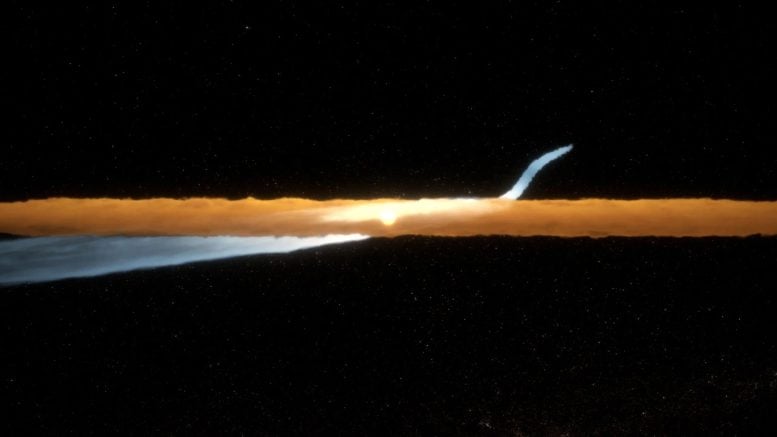
Astronomers using the Hubble Space Telescope have captured a structure some 93 billion miles long in visible light for the first time, ending a puzzle that began when the James Webb Space Telescope detected the feature’s heat but no telescope working in ordinary light could see it at all. The structure, nicknamed the “Cat’s Tail,” curves out of the debris disk surrounding Beta Pictoris, a young star 63 light-years from Earth in the southern constellation Pictor. It stretches across as much as 1,000 astronomical units — one astronomical unit being the distance from the Earth to the Sun — making it one of the largest coherent dust features ever recorded around another star.
Beta Pictoris has been a fixture of planet-formation research for four decades. The star is roughly 20 million years old, a fraction of the Sun’s 4.6 billion years, and it is surrounded by a vast, edge-on disk of dust and rocky debris: the leftover building material of a planetary system still under construction. At least two giant planets have been directly imaged inside the disk, and astronomers treat the system as a nearby laboratory for the violent early stages through which our own solar system passed billions of years ago. It is in that disk that the Cat’s Tail sits, protruding out of the disk’s plane like a streamer pulled sideways from a spinning wheel.
Webb found the tail first. Observing in infrared light, which registers the heat radiated by dust grains, the telescope revealed a curved, threadlike feature extending far from the star that had no obvious counterpart in decades of earlier observations. That absence was the mystery. Debris disks shine in visible light by reflecting their star’s light, and Beta Pictoris’s disk is bright and well photographed. A structure as large as the Cat’s Tail should have reflected light too. Instead, at visible wavelengths, it was simply not there — as if the dust were absorbing light rather than scattering it back toward Earth.
The new work, led by Arin Avsar, a planetary science doctoral student at the University of Arizona, attacked the problem with Hubble’s Space Telescope Imaging Spectrograph and more than 14 years of accumulated observations, combining imaging from 2012 through 2025. By stacking and comparing that long record, the team pulled the tail out of the glare of the star and measured it in scattered visible light for the first time. Their findings were published in The Astrophysical Journal Letters on October 7, in a paper co-authored with Kevin Wagner, Dániel Apai, Isabel Rebollido and colleagues from the university’s Lunar and Planetary Laboratory and Steward Observatory, together with researchers at other institutions.
What they found explains the years of invisibility. The tail is made almost entirely of what astronomers call organic refractory material: heavily carbon-based matter built from long chains of carbon atoms. That material is, in Avsar’s description, quite black — it absorbs visible light instead of reflecting it, which is why the structure hid from every visible-light telescope while glowing in Webb’s infrared view. The individual grains are tiny, about a micron across, and remarkably porous and fluffy for debris supposedly produced by a high-speed impact. Standard models of planetary collisions do not naturally produce dust of quite that character, and the mismatch is one of the open questions the paper leaves on the table.
The leading explanation for the tail’s existence is a catastrophe. “The Cat’s Tail is thought to be the aftermath of a collision between large bodies — think something like Pluto,” Avsar said. On that account, two dwarf-planet-sized worlds in the young system struck each other, and the impact sprayed an enormous quantity of dark, carbon-rich debris into a streamer that radiation and gravity have since drawn out across hundreds of astronomical units. The paper is careful to present this as a proposed explanation rather than a confirmed reconstruction: no one watched the collision happen, and the evidence is the shape, composition and position of the dust itself, preserved like a skid mark long after the event.
The geometry adds a further twist. The tail’s apparent length, the team found, lies mostly across our field of view rather than extending deep into space along the line of sight — which is to say the 1,000-AU figure is close to a true physical scale, not a trick of perspective inflating a smaller feature. The observations also revealed something separate: a previously unseen warp in the broader dust halo around the star. That distortion, the researchers say, may be the gravitational fingerprint of the system’s giant planets, including Beta Pictoris b, a gas giant roughly ten times the mass of Jupiter whose pull can bend the orbits of the debris through which it moves.
For astronomers, the value of the work is the rarity of the evidence. Collisions between Pluto-sized bodies are a predicted and necessary stage in building planets — the early solar system is thought to have been shaped by many of them, including the impact that formed Earth’s Moon — but catching the aftermath in another system, in two different kinds of light, over a 14-year baseline, is unusual. The Cat’s Tail amounts to a preserved record of one such event, written in dust dark enough to have hidden in plain sight around one of the most closely watched young stars in the sky.
What remains unexplained is the dust itself: how an impact between rocky-icy worlds produced grains so fluffy, so porous and so black, and how the streamer has held together as a coherent feature across such a span. Further observations, and modelling aimed at reproducing the tail’s exact shape and brightness in both infrared and visible light, will decide whether the collision story stands as written — or whether Beta Pictoris is showing astronomers something they have not seen before.
The Facts
- Beta Pictoris is a young star 63 light-years from Earth in the constellation Pictor, roughly 20 million years old.
- The Cat's Tail stretches across as much as 1,000 astronomical units — about 93 billion miles.
- The James Webb Space Telescope detected the tail in infrared light; Hubble has now imaged it in visible light for the first time, using observations spanning 2012–2025.
- The dust is almost entirely carbon-rich organic refractory material — black, light-absorbing grains about a micron across, exceptionally porous and fluffy.
- The leading explanation is a collision between two large, Pluto-sized bodies in the young system; the paper presents it as a proposal, not a confirmed reconstruction.
- The same observations revealed a warp in the star's dust halo, possibly caused by Beta Pictoris b, a gas giant about ten times the mass of Jupiter.
- The study, led by Arin Avsar of the University of Arizona, was published in The Astrophysical Journal Letters on October 7, 2026.
Sources: Avsar et al., “Deep HST/STIS Coronagraphic Imaging of the β Pictoris Debris Disk,” The Astrophysical Journal Letters (October 7, 2026); University of Arizona; SciTechDaily; Vice.



Comments