
Brazil votes on Sunday, October 25, in a presidential runoff between President Luiz Inácio Lula da Silva and Senator Flávio Bolsonaro, after neither man won the majority of valid votes needed to take the presidency in the first round on October 4. A series of polls published on Saturday showed the two about even, Reuters reported, with the first-round winner, Bolsonaro, numerically ahead in each survey and every lead inside the poll’s margin of error. Polling stations open at 8 a.m. and close at 5 p.m. Brasília time, and the electoral court begins publishing the count at 5 p.m. — 4 p.m. Eastern time in the United States.
In the first round, Bolsonaro, of the Liberal Party, took 56,104,268 votes, or 47.03 percent of valid votes, and Lula, of the Workers’ Party, took 53,876,617 votes, or 45.16 percent, according to Brazil’s Superior Electoral Court (TSE), a gap of just over 2.2 million votes. Brazil requires a presidential candidate to win more than half of valid votes to avoid a runoff. The result split the country on the map: Lula won most states across the Northeast and parts of the North, while Bolsonaro ran strongly across the South, Southeast and Centre-West and won the two largest states, São Paulo and Rio de Janeiro. It was also a result the pollsters had not forecast — a Datafolha survey in mid-September, for example, had Lula at 39 percent and Bolsonaro at 36, a statistical tie.
Bolsonaro, 45, is a senator for Rio de Janeiro state running for the presidency for the first time. He is the son of former President Jair Bolsonaro, who is serving a 27-year sentence after being convicted over a plot to overturn the result of the 2022 election, and he has pledged to seek legal pardons for his father and for others convicted over the January 8, 2023 storming of government buildings in Brasília that followed his father’s defeat. He has repeated one of his campaign’s central proposals since the first round: ending presidential reelection. “I only need one term,” he told supporters. Lula, 80, is in his third term as president — he governed from 2003 to 2010 and returned to office in 2023 — and is seeking a fourth, non-consecutive term. He told supporters late on the night of the first round that he had expected to win outright: “I confess I was convinced I would win the election in the first round.”
A Campaign Run On Crime, Corruption And The Cost Of Living
CNN described a first-round campaign dominated by crime, corruption and Donald Trump. Bolsonaro is an ally of the U.S. president, and Lula has predicted that the Trump administration will try to tilt the race, saying on a podcast: “They will try to interfere here. They will try to help the other side win the elections.” At home, the arguments ran over public security, corruption scandals and the cost of living, with Lula campaigning on his record in government and the Workers’ Party’s social programs, and Bolsonaro drawing on dissatisfaction with the current administration. Since October 4, the voters of the eliminated candidates have been the prize: Augusto Cury and Renan Santos, who finished third and fourth with a combined 6.1 million votes, have said they will not endorse either man, while Ronaldo Caiado, who finished fifth with 2.6 million votes, announced his support for Bolsonaro on October 6.
The Voters Who Stayed Home
More than 158 million people are eligible to vote, and turnout in the first round was 78.9 percent — which leaves more than 33 million eligible voters, about 21 percent of the electorate, who did not cast a ballot on October 4. Under Brazil’s compulsory voting rules they can face a small fine for failing to vote without justification, but missing the first round does not bar anyone from voting in the second: those 33 million can still take part on Sunday. Both campaigns spent Saturday chasing them and the remaining undecided. Lula held a morning rally on Copacabana beach in Rio de Janeiro and then what The Associated Press described as possibly the biggest rally of his career on São Paulo’s Avenida Paulista, telling supporters “the people have taken it upon themselves to lead the campaign.” Bolsonaro brought supporters out in his native Rio de Janeiro and in Belo Horizonte, capital of Minas Gerais, the state that has pointed to the winner of the country’s presidential elections for decades.
How Sunday Works
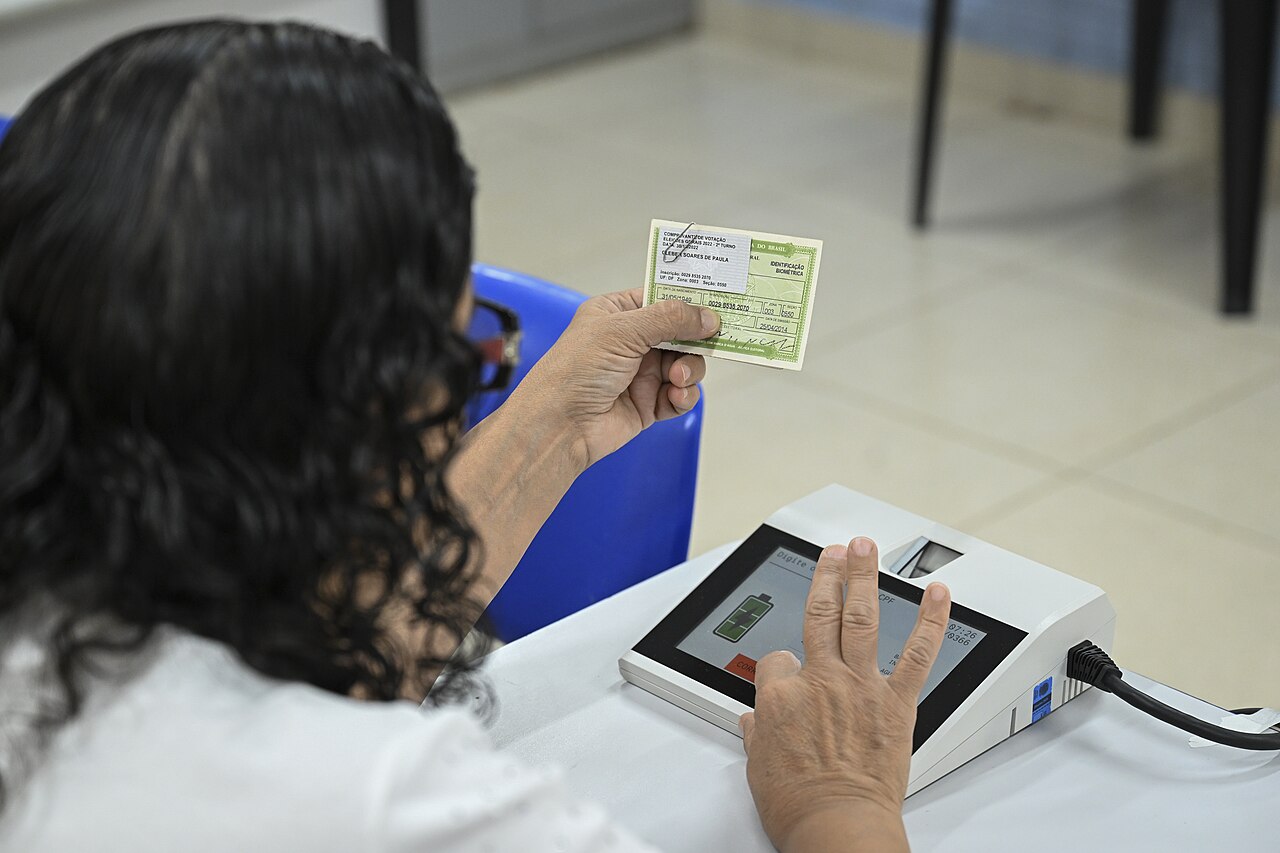
Voting is compulsory for literate Brazilian citizens aged 18 to 70, and optional for voters aged 16 and 17, those over 70, and those who cannot read or write. Brazilians vote on electronic machines, keying in the number assigned to their candidate; blank and invalid ballots do not count toward either candidate’s total, and the man with more valid votes on Sunday wins. Because the vote is electronic, the count moves quickly: the TSE starts publishing results the moment polls close at 5 p.m. Brasília time, and the outcome is typically known within hours. Voters in five places — Acre, Amazonas, Espírito Santo, Tocantins and the Federal District — will also choose a governor in a runoff on Sunday.
The Final Polls, In Short
- Datafolha (surveyed October 23–24, 4,050 people, margin of error 2 points): Bolsonaro 48 percent, Lula 47 percent.
- AtlasIntel/Bloomberg (October 18–23, 4,990 people, margin of error 1 point): Bolsonaro 49.9 percent, Lula 48.4 percent.
- Quaest (October 23–24, 3,702 people, margin of error 2 points): Bolsonaro 46 percent, Lula 45 percent.
- BTG/Nexus (October 23–24, 2,000 people, margin of error 2.2 points): Bolsonaro 47.0 percent, Lula 46.0 percent.
- CNT/MDA (October 21–23, 2,032 people, margin of error 2.2 points): Bolsonaro 46.3 percent, Lula 45.0 percent.
Sources: Reuters; The Associated Press; CNN; Brazil’s Superior Electoral Court (TSE).
Comments
Loading comments…