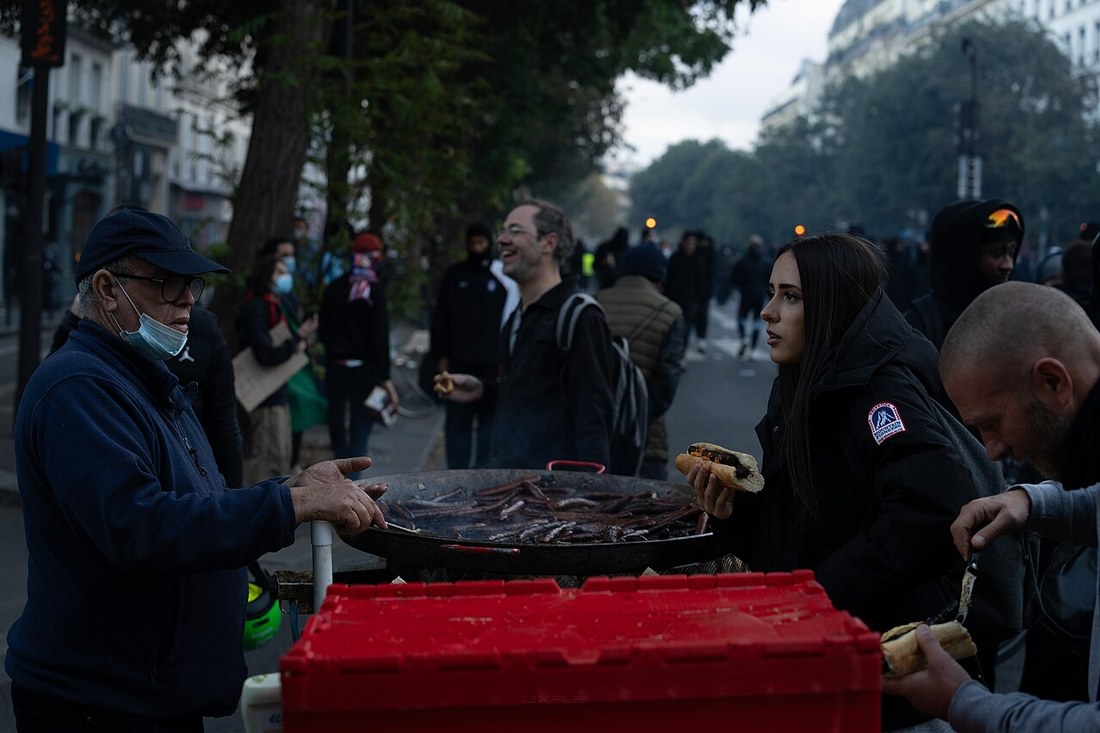
PARIS — They called it Black Thursday, and by the time the marches reached their ends, the count stood at almost 600,000 people in around 200 demonstrations across France — the largest single day of the protest movement that has rolled through the country in waves since September, and, according to 9 News’ report from the streets, the biggest general strike since that unrest began.
The demands have been consistent for two months now: higher wages against a cost of living that keeps outrunning them, money for schools and universities, and public services that protesters say are being cut past the bone. Some 16 percent of teachers were on strike, and around 90 percent of universities were reported blockaded by students — one of the banners in Paris read, in French, “You want us to study — think about our hunger.” Rail services, air traffic control, ports and schools all took disruption.
Mostly peaceful — with edges
The bulk of the day was marching, and most of it was peaceful. The edges were not. In Paris, police fired tear gas and flash-bang grenades as they moved in on demonstrators around Place de la Nation toward the scheduled end of the march, with a CBS News reporter broadcasting from inside the cordon in a press helmet and respirator. In Lyon, scuffles broke out, cars were set on fire and firefighters were called to blazes; Nantes saw clashes as well. The Independent’s footage from across the country showed the same pattern repeated at different scales: dense crowds, lines of riot police, flares, and then the smoke.
A government with no room
The political problem underneath the tear gas is arithmetic. President Emmanuel Macron, quoted in CGTN Europe’s reporting from Paris, said genuine concerns must be listened to but violence will not be tolerated — the standard presidential formula, delivered into a situation where listening is cheap and answering is not. Prime Minister Sébastien Lecornu met unions and student groups through the protest period, but his government is trying to pass a budget through a deeply divided parliament, and every euro offered to the streets is a euro that has to survive a chamber that has already broken governments over less.
That is why the movement has lasted since September rather than burning out after a single strike day: the grievances are budgetary, the budget is stuck, and the street knows it. Thursday’s turnout — the largest yet — was the movement’s way of saying the offers so far are not enough. The unions have vowed to keep pushing. On the evidence of this week, the winter in France will be loud.
The movement’s durability has a shape: since the first wave in September, the unions have returned to the streets in rolling one-day strikes rather than an open-ended stoppage — a rhythm that keeps pressure on the government without exhausting the strikers, and that has steadily grown rather than faded. Thursday’s count was the proof of the method. Each round has been organised around the same core of demands, and each round has ended with the same promise to return. The budget, when it finally comes to a vote in a National Assembly where the government has no majority, will be the test of whether the street or the chamber blinks first.
The Facts
- Almost 600,000 people attended around 200 demonstrations across France, the largest turnout since the unrest broke out in September
- The marches were largely peaceful; scuffles were reported in Lyon and Nantes, and police used tear gas in Paris
- Demands centre on wages, the cost of living, education funding and public services; about 16% of teachers struck and some 90% of universities were reported blockaded
- Prime Minister Sébastien Lecornu met unions and student groups; President Macron said genuine concerns must be heard but violence will not be tolerated
Sources: 9 News and CNA/Reuters footage of the nationwide demonstrations; CGTN Europe reporting from Paris; Fox News coverage of the ‘Black Thursday’ strike day; The Independent’s protest coverage.
Comments