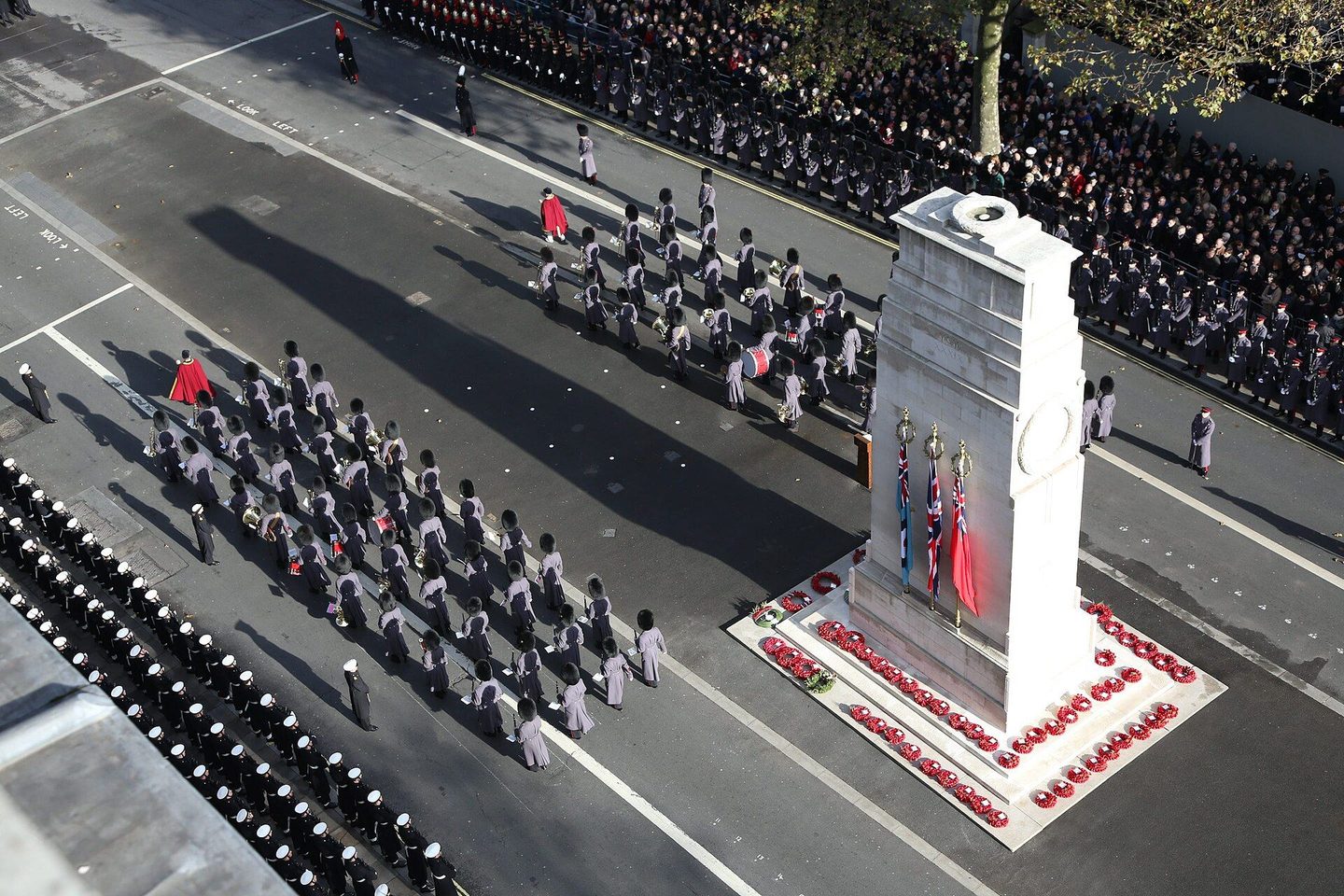
LONDON — King Charles III led the nation in the two-minute silence at the Cenotaph on Sunday, laying the first wreath at the Whitehall memorial at the head of a National Service of Remembrance that brought together the Royal Family, the government, a record nine former prime ministers and some 10,000 veterans who marched past in the November cold.
At the first stroke of Big Ben at 11 a.m., Whitehall fell silent, the silence marked by gunfire from the King’s Troop Royal Horse Artillery on Horse Guards Parade. The King, wearing the uniform of a Marshal of the Royal Air Force, laid the first wreath of poppies and saluted at the foot of the Cenotaph beneath the words “The Glorious Dead.” His wreath carried a handwritten message: “In everlasting remembrance.” The Prince of Wales laid a wreath bearing the Prince of Wales feathers and a ribbon in Welsh red, while Queen Camilla and the Princess of Wales watched from a balcony overlooking Whitehall, and wreaths followed from political leaders, Commonwealth representatives and the armed services.
The wreath, and his grandfather’s
The King’s wreath follows the design traditionally produced for his grandfather, George VI: 41 open-style poppy petals of bonded fabric mounted on black leaves, 27 inches across, finished with a ribbon and bow in scarlet, purple and gold — the colours of the King’s racing silks. The detail was noted by royal watchers as a deliberate thread back to the wartime king in whose reign the Cenotaph ceremony took its modern form.
Nine former prime ministers
The political attendance set its own record. Prime Minister Andy Burnham attended his first Remembrance Sunday in office, and around him stood nine former prime ministers — Keir Starmer, Rishi Sunak, Liz Truss, Boris Johnson, Theresa May, David Cameron, Gordon Brown, Tony Blair and John Major — a gathering the BBC noted would have been impossible a generation ago: when Blair left Downing Street in 2007, only two former prime ministers, Major and Margaret Thatcher, were still alive. After the service, around 10,000 veterans representing more than 300 armed forces and civilian organisations marched past the Cenotaph.
The night before, and the year it marks
On Saturday evening the King had led senior royals at the Royal British Legion’s Festival of Remembrance at the Royal Albert Hall, broadcast on BBC One and hosted by Clive Myrie, with performances including Alfie Boe and Mica Paris; this year’s BBC theme is Places of Remembrance. The 2026 service falls in a year of anniversaries — 35 years since the end of the First Gulf War and 15 since the conclusion of British military operations in Iraq under Operation Telic. Remembrance Sunday is held on the Sunday closest to Armistice Day, November 11, the date the First World War ended in 1918; the national ceremony at the Cenotaph, which means “empty tomb,” has been held for more than a century.
Services were held at war memorials across the country through the morning, and among those preparing to march in Whitehall was Annie Duplock, who served in the Women’s Land Army during the Second World War and told the BBC she was excited and apprehensive ahead of the march-past. Commemorations continue on Wednesday, when the country marks Armistice Day itself with a further two-minute silence at 11 a.m., 108 years after the guns fell silent on the Western Front.
The Facts
- King Charles III led the National Service of Remembrance at the Cenotaph in Whitehall on Sunday, observing the two-minute silence at 11 a.m.
- The King, wearing the uniform of a Marshal of the Royal Air Force, laid the first wreath; its handwritten message read ‘In everlasting remembrance’
- The King’s wreath echoes the design traditionally made for his grandfather George VI: 41 open poppy petals on black leaves, with a ribbon in his racing colours of scarlet, purple and gold
- Around 10,000 veterans from more than 300 organisations marched past the Cenotaph
- A record nine former prime ministers attended — Starmer, Sunak, Truss, Johnson, May, Cameron, Brown, Blair and Major — alongside Prime Minister Andy Burnham, at his first Remembrance Sunday in office
- The service fell in the year marking 35 years since the end of the First Gulf War and 15 years since the end of British operations in Iraq
Sources: BBC News coverage of the National Service of Remembrance and the Royal British Legion’s Festival of Remembrance; the Press Association; People magazine’s reporting from Whitehall; Royal Central on the design of the King’s wreath, November 8, 2026.
Comments