
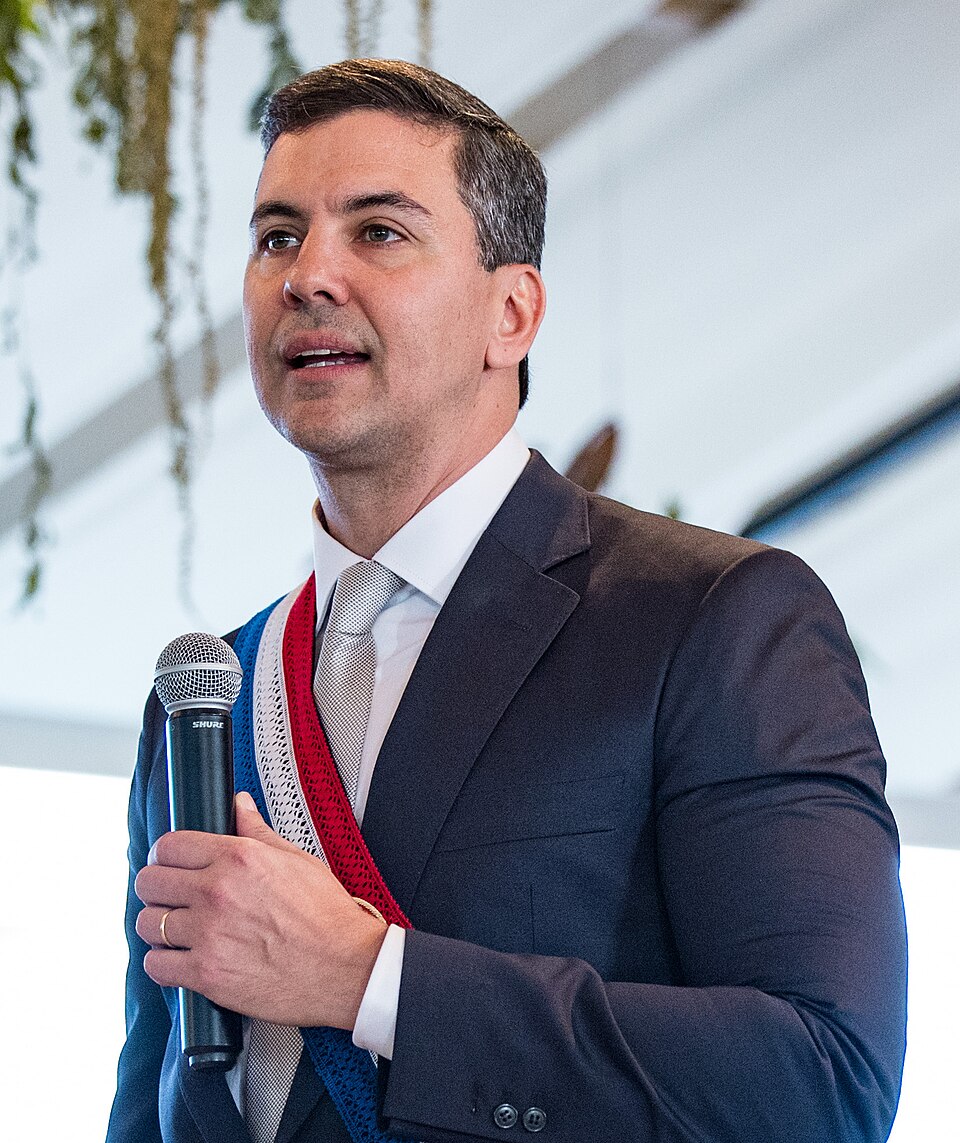
ASUNCIÓN — Paraguay’s President Santiago Peña resigned on Thursday, undone by the collapse of a digital bank tied to his government that left some 3 million customers — nearly half the country — unable to reach their money. He announced the decision in a video posted on social media while lawmakers inside the Legislative Palace were already debating whether to impeach him, Reuters and the Associated Press reported.
“I have made the decision to submit my resignation from the Presidency of the Republic. I do so with the stability of our country, social peace, and the need to preserve our public institutions in mind,” Peña said. Minutes later, the Chamber of Deputies voted 78-0 to impeach him anyway — a unanimous repudiation in which members of his own long-ruling Colorado Party joined the opposition, the AP reported. The charges now go to the Senate, where a two-thirds majority is required to convict and formally remove him. Under Paraguay’s constitution, Congress must accept or reject a presidential resignation; the AP reported Congress was expected to accept Peña’s formally on Thursday afternoon, clearing the way for Vice President Pedro Alliana to be sworn in as his successor.
The Bank That Swallowed A Presidency
Ueno — it styles itself with a lowercase “u” — grew in under five years from a niche fintech company into a household name, a mid-tier bank claiming more than 60 per cent of Paraguay’s adults as customers. As of June it said it had around 3 million customers in a country of 6.5 million people, and it administered roughly $850 million in public funds, including money from the Social Security Institute, which manages most workers’ pensions, and from the operators of Paraguay’s giant hydroelectric dams, according to Reuters and the AP.
On Tuesday the Central Bank of Paraguay intervened, putting ueno into resolution — its strongest measure short of immediate liquidation — after determining that the lender’s solvency ratio had fallen below half the legal minimum. Savings were frozen in the middle of the night. The central bank said it was working to transfer customer accounts to other financial institutions, a process that strained the banking system and caused outages at several banking apps, Reuters reported. Regulators investigating ueno’s loans to companies linked to its owners found poorly documented lending and expenses the bank had wrongly counted as assets.
The President’s Stake
What made the failure fatal for Peña, 47, is his own history with the bank. An economist elected in 2023 who took office that August for a five-year term, he was a shareholder in Grupo Vázquez, the conglomerate that owns ueno, until March 2025, when he says he sold his stake. Ueno says Peña never held a direct stake in the bank itself, as shareholder or investor. Opposition lawmakers — joined, in the end, by dissidents from his own party — accused him of conflict of interest, misuse of pension funds and an institutional cover-up, and 35 of them brought the charges of “serious and systematic dereliction of duty” that Congress was debating when he quit. Prosecutors said on Thursday that Peña is among those being investigated over the bank’s failure, though he has not been taken in for questioning; arrest warrants were issued this week for eight ueno executives, Reuters reported. Earlier this week Peña approved legislation to speed payments to depositors caught in the collapse, and in his resignation message he offered an apology — but stopped short of accepting responsibility for the crisis.
A Central Bank Chief Gone, Protesters In The Streets
The first head to roll was not the president’s. Carlos Carvallo, the governor of the central bank, resigned on Tuesday after his institution seized ueno; he had previously been the digital lender’s own chief. By Thursday, protesters were in the streets of the capital for a third day demanding Peña’s resignation and the return of frozen savings, wages and pensions, and the president had lost the backing of members of his own conservative party — the point at which, Reuters reported, the decision to go was made.
Peña, a close ally of US President Donald Trump, leaves office barely halfway through a term that was due to run to 2028. If Congress completes the steps set out on Thursday, Alliana will serve out the remainder. For a country long prized by foreign investors for its stability, the week has delivered a failed bank, a fallen central bank governor, eight executives facing arrest, and a president impeached by a unanimous lower house minutes after he resigned — all of it flowing from one digital lender that grew too fast, held the nation’s pensions, and fell below half the capital the law required it to hold.
The Facts
- The resignation: announced by video on Thursday, November 5, while Congress was debating impeachment; the Chamber of Deputies then voted 78-0 to impeach (AP).
- The successor: Vice President Pedro Alliana, once Congress formally accepts the resignation, as Paraguay’s constitution requires.
- The bank: ueno, a digital lender with around 3 million customers in a country of 6.5 million; it administered roughly $850 million in public funds, including pension money.
- The failure: the central bank seized ueno on Tuesday after its solvency ratio fell below half the legal minimum; accounts were frozen and are being transferred to other banks.
- The link: Peña was a shareholder in ueno’s parent, Grupo Vázquez, until March 2025; prosecutors are investigating him, and arrest warrants were issued for eight ueno executives.
- The first casualty: central bank governor Carlos Carvallo, formerly ueno’s own chief, resigned on Tuesday.
Sources: Reuters, November 5, 2026 (resignation, ueno explainer, Carvallo resignation, prosecutors and arrest warrants, account transfers); Associated Press, November 5, 2026 (78-0 impeachment vote, congressional acceptance and Alliana succession timetable, lending findings, protests); CNN, November 5, 2026 (resignation statement, charges, solvency ratio); BBC News, November 5, 2026 (front-page carriage).



Comments