
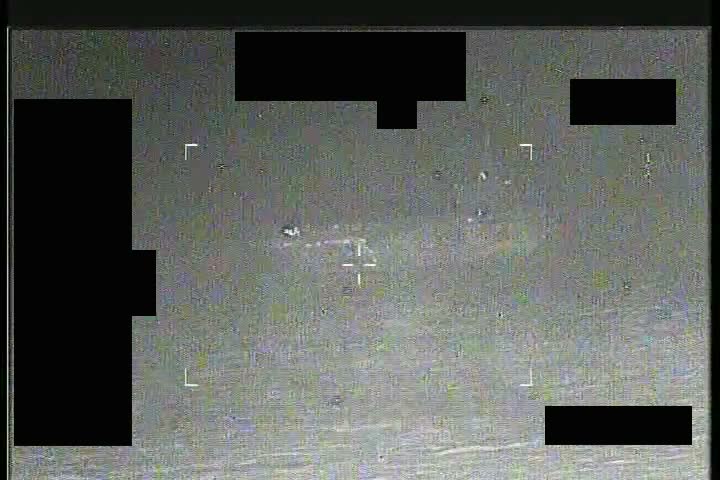
On Friday, November 20, the Department of War published the eighth batch of its UFO files — 43 records, 40 documents and three videos, taking the public archive built since May to 521 files. One clip has outrun all the others: 20 seconds of infrared from the Middle East, filmed in 2020, which the Daily Mail — which had the files ahead of release — headlined as a tiny object glowing white-hot and overtaking a US warship. The footage is real, and it is now public, and you can watch it above. What the government’s own paperwork says about it is more careful, and more interesting, than the headline.
The Clip, In The Government’s Words
The video is catalogued as DOW-UAP-PR166, an unresolved UAP report submitted by US Central Command to the All-domain Anomaly Resolution Office. AARO’s official description is timed and deliberately flat: ‘00:00–00:09: An area of contrast enters the sensor field-of-view from the right edge of the frame, proceeding from right to left. 00:10–00:20: The sensor pans and cycles the level of magnification to track the area of contrast, keeping it generally within the center of the frame.’ The listing gives no ship, no platform type, no location beyond the Middle East and no date beyond 2020; the sensor’s own data readouts are covered by black redaction blocks. It ends with the archive’s standing warning: the description ‘should not be interpreted as reflecting an analytical judgment, investigative conclusion, or factual determination’ about the event.
The Warship Question
So: did an object overtake a warship? The official description never says so. It identifies the camera’s home only as ‘a US military platform’; it records no pass, no chase and no speed, and the Pentagon states the imagery cannot establish the object’s size, distance or velocity. The warship entered the story through the imagery itself — the dark mass in frame that the Mail read as a vessel’s bow — and through early coverage describing the sensor as ship-mounted. That reading may even be right about where the camera sat. But ‘overtaking’ claims a race the record does not contain, and the correction matters precisely because the genuine article is remarkable enough: the Pentagon filmed something it cannot identify, kept the file for six years, and has now published it, unresolved, for anyone to watch.
The batch’s other two videos are of the same character. A 13-second clip from 2023, shot from above, shows a small dot making sudden, sharp changes of direction. A 54-second clip from 2026 shows several dots crossing the frame together while the sensor zooms to follow them, briefly losing two. All three were selected for release, the department says, because its analysts still cannot resolve them.
Mach 2.5, Maybe
The documents hold their own headline. One file records a 2023 case in which a civil air-surveillance radar over North America made eight detections in 84 seconds, between 55,000 and 70,000 feet. If the detections were a single object on a continuous track, it covered about 38.5 miles in that span — a minimum average speed of some 1,650 miles per hour, around Mach 2.5 — with a change of heading of roughly 39 degrees along the way. The file itself supplies the caveat: the data cannot prove the eight detections were one object. Both halves of that sentence are the story.
The Man Who Built The SR-71 Saw Something
The historical files reach back to December 16, 1953, when Clarence ‘Kelly’ Johnson — Lockheed’s chief engineer, the designer of the U-2 and the SR-71 — watched the sunset from his ranch near Agoura, California, and saw a dark, elliptical object hanging motionless against a ‘gold and red’ sky. His report, dated January 20, 1954, is in the release in full. So is the Air Force’s verdict, filed alongside it: a lenticular cloud.
The Vault
And then there is the paperwork that sounds least like paperwork. The batch includes the complete 538-page ‘Ten Month Report’ of Bigelow Aerospace Advanced Space Studies, the contractor that ran the DIA’s Utah ranch investigation. In it, BAASS sets out its need for a ‘highly secure underground vault’ for hardware and biological samples: a facility in North Las Vegas, buried 15 to 20 feet down, a 5,000-square-foot vault behind three-foot walls and a thick steel door, its surface buildings ‘extensively camouflaged’. A version of the report leaked last year; Friday was the first time the Pentagon has released it officially.
The department’s posture toward all of it is deliberate non-posture. It told The Independent it had nothing to add about the warship sighting, and that it is offering no assessment of any file so that Americans can reach their own conclusions. The archive, meanwhile, keeps growing: eight batches, 521 records, and more tranches in preparation. The government is no longer arguing about whether the public should see this material. It is publishing it, unresolved, and standing back.
The batch’s paperwork spans the whole life of the subject: six of the 43 records come from the CIA, reaching back to the agency’s earliest UFO-era papers of 1952, and only three files in the entire release are flagged as redacted. The political frame was set back in February, when the president ordered the files opened; Pentagon spokesman Sean Parnell has called the releases the fulfilment of that pledge of full transparency, and Defence Secretary Pete Hegseth has said it is time for the American people to see the files with their own eyes. Release 08 is what that instruction looks like in practice — the evidence locker emptied onto a website, labels and all.
Sources: US Department of War, PURSUE Release 08 and DVIDS listing DOW-UAP-PR166, November 20, 2026; Daily Mail, November 20–21, 2026; The Independent, November 2026.

Comments