
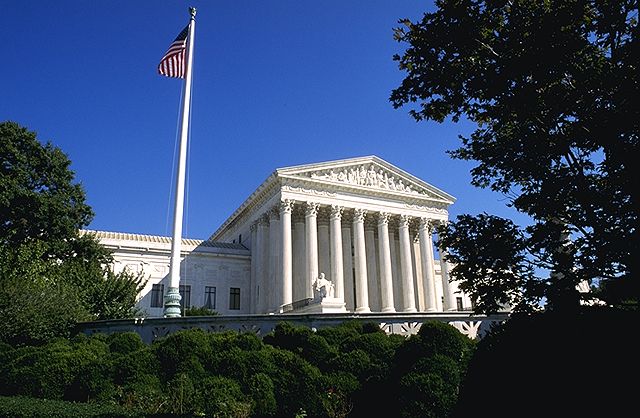
WASHINGTON — The Supreme Court will hear a case on November 9 that could eliminate the already limited ability of individuals to sue federal agents for constitutional violations, USA Today reported. Decades of Supreme Court decisions have limited the ability to seek damages from a federal employee accused of violating someone’s constitutional rights. Depending on the outcome of the case, such suits could be blocked entirely.
The lawsuit gives the court’s 6–3 conservative majority an opportunity to overturn what is left of a 1971 decision, Bivens v. Six Unknown Named Agents, that allowed people to sue federal officers for monetary damages, USA Today reported. The report noted that widely shared images of immigration enforcement agents using violence to carry out the Trump administration’s immigration crackdown have put a spotlight on how difficult it is to take federal officers to court.
The case before the court
The plaintiff in the $3 million suit against a federal prison nurse is Kekai Watanabe, who says he should have been hospitalized or seen a specialist after being attacked during a gang-related fight at a prison in Honolulu in 2021. Instead, he was given over-the-counter pain medication and told to “stop being a cry baby,” Watanabe alleges. An X-ray taken months later showed that he had a fractured coccyx and that bone chips had migrated to surrounding soft-tissue areas. He did not receive further treatment before being released in 2024 and remains in tremendous pain today, according to his lawyers.
An appeals court said Watanabe’s claim passes the test the Supreme Court has set for such suits, ruling that it is identical to a 1980 Supreme Court decision in which the court said federal prison staff violated the Eighth Amendment’s ban on cruel and unusual punishment when they failed to respond appropriately to a prisoner’s fatal asthmatic attack.
What Bivens is, and how it has narrowed
The 1971 Bivens decision allowed people to sue federal officers for monetary damages over constitutional violations. In recent years, the court has sought to limit the ability to sue federal employees, including barring lawsuits in cases that are “different in a meaningful way” from the details spelled out in Bivens or in the only two other cases in which the Supreme Court has allowed similar constitutional claims, USA Today reported. The 1971 decision is criticized by conservatives who think the then-liberal Supreme Court used it to grant rights that are not spelled out in the Constitution.
The arguments the justices will hear
The Justice Department argues that the 1980 decision on which Watanabe’s claim rests is now “obsolete” because of more recent Supreme Court rulings limiting its reach. “This Court should say as much,” the Justice Department wrote in a filing. Attorneys for the prison nurse argue that the justices should go further and also get rid of the 1971 Bivens decision that underpinned the 1980 ruling. “Those cases are relics of the bygone days when federal courts thought it appropriate to create causes of action Congress had not authorized,” the nurse’s attorneys said in written arguments. “The Court has since rejected every stitch of Bivens’s reasoning.”
Lawyers for Watanabe counter that Congress effectively authorized such lawsuits when it passed legislation in 1996 that limited — but did not end — those claims. USA Today reported, however, that recent rulings suggest many justices believe Congress must pass a bill explicitly creating a right to sue. Rory Little, who teaches constitutional and criminal law at the University of California College of the Law, San Francisco, predicted that the court will either “overrule an old civil rights precedent” or “once again” say it does not apply to the latest case. The result, Little wrote, “seems pretty much preordained.”
Why immigration agents are in the frame
Erwin Chemerinsky, dean of the law school and a professor of law at the University of California, Berkeley, said the case has taken on special significance amid calls to hold immigration agents and others accountable for actions like the fatal shootings of Renee Nicole Good and Alex Pretti in Minneapolis earlier this year. “If Bivens is eliminated, then there’ll be literally no way to sue in federal court when a federal agent like ICE violates the Constitution,” he said. The case is Watanabe’s suit against a prison nurse, not an immigration case; USA Today reported that its outcome would decide whether the Bivens route remains open at all for people who say a federal agent — such as an Immigration and Customs Enforcement officer — violated their constitutional rights. Arguments are set for November 9.
The Facts
- The Supreme Court hears arguments on November 9 in a case that could block entirely the limited ability to sue federal agents for constitutional violations
- The case is a $3 million suit by Kekai Watanabe, who alleges a federal prison nurse gave him only over-the-counter pain medication after a 2021 prison attack in Honolulu that fractured his coccyx
- The suit rests on Bivens v. Six Unknown Named Agents (1971), which allowed monetary-damages suits against federal officers; the court has since barred claims “different in a meaningful way” from Bivens and two other allowed cases
- An appeals court ruled Watanabe’s claim identical to a 1980 decision on prison staff and the Eighth Amendment; the Justice Department calls that decision “obsolete,” and the nurse’s attorneys ask the court to overturn Bivens itself
- Watanabe’s lawyers argue Congress effectively authorized such suits in 1996 legislation that limited but did not end them
Sources: USA Today, November 8, 2026, reporting the case the Supreme Court will hear on November 9, the parties’ filings and comments by Erwin Chemerinsky and Rory Little.

Comments