

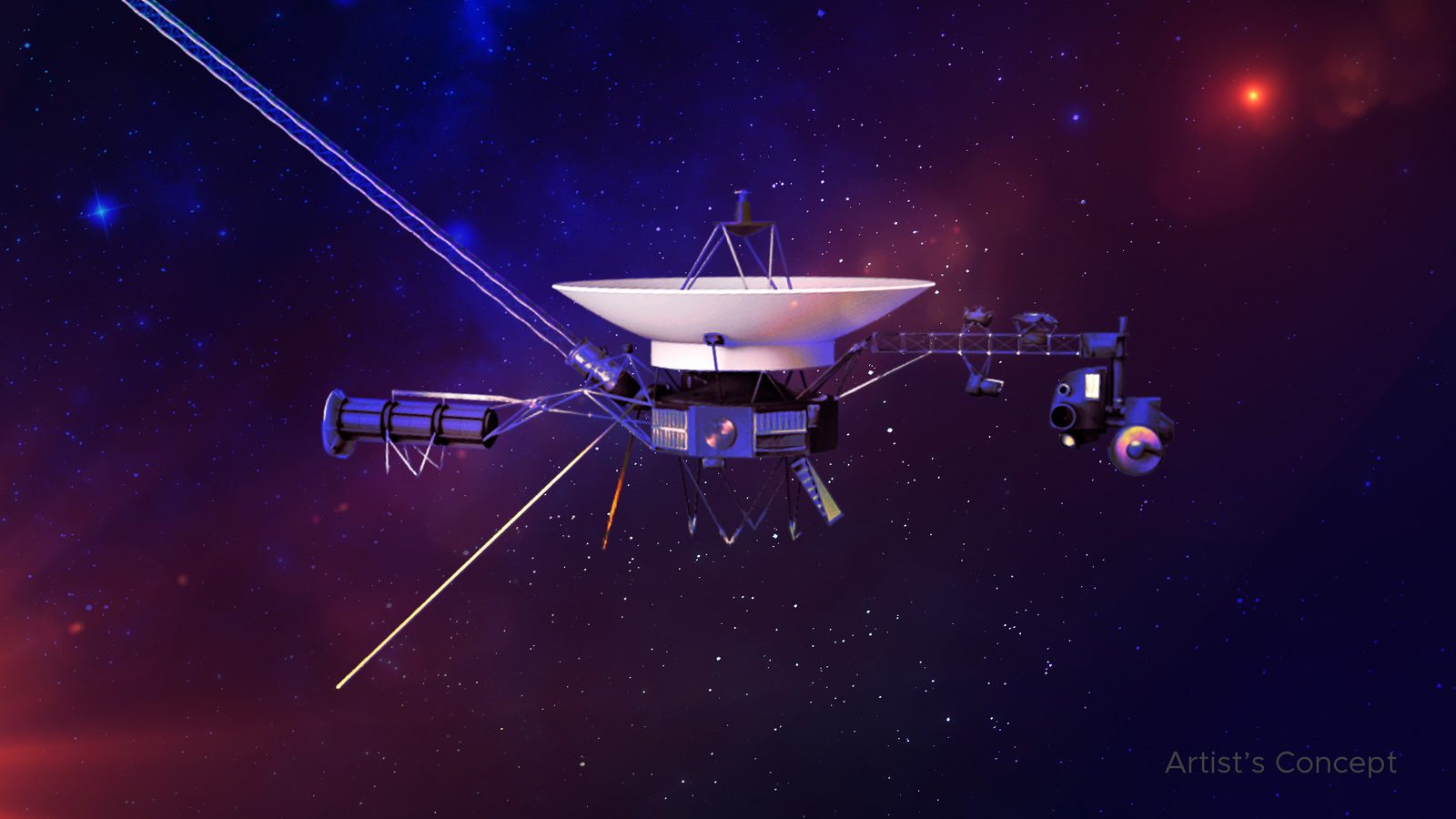
Voyager 1 reached one light-day from Earth at 2:16 a.m. Pacific time on Wednesday, NASA said — the first human-made object to travel so far that its radio signals need a full day to reach home. The mission team at the Jet Propulsion Laboratory heard the confirming signal 24 hours later, early on Thursday. The spacecraft that sent it is, at the same time, unable to send any science or engineering data at all.
One light-day is about 16.1 billion miles — 25.9 billion kilometres, or roughly 173 times the distance from the Earth to the Sun. Sunlight takes eight minutes to reach Earth; Voyager 1’s signal, travelling at the same speed, takes 1,440. The spacecraft reached the mark 49 years, two months and 11 days after its launch on September 5, 1977, and it is still moving away, at about 38,000 miles an hour.
Engineers confirmed the milestone from the spacecraft’s carrier signal and its trajectory calculations. The carrier is the underlying radio transmission on which Voyager’s data normally rides. NASA announced the milestone on Thursday and held a discussion of it at JPL at noon Eastern the same day, with project scientist Linda Spilker and project manager Suzanne Dodd, taking questions on the milestone and the silence alike.
A Carrier Signal, But No Data
The mission has received no science or engineering data from Voyager 1 since November 14. On that day, a Deep Space Network antenna in Canberra, Australia, locked onto the spacecraft and received its carrier signal — but no data on it. The carrier’s presence told engineers two things: the spacecraft’s attitude control computer is keeping it pointed at Earth, and its antenna and broadcast equipment are still working.
“The lack of data suggests the issue is with the onboard computer responsible for collecting the data from the spacecraft’s various subsystems, including science instruments, and putting it into the right format to be transmitted to Earth,” NASA said in its November 18 update. The agency has not confirmed the cause. Engineers are analysing the data they have, and are investigating whether the problem is connected to a communications gap in October.
The computer at the centre of the problem is the flight data subsystem, one of three computers aboard. Voyager 1’s computers were built in the 1970s with about 69.63 kilobytes of memory each — less storage than a single photograph on a modern phone. The FDS collects measurements from the spacecraft’s instruments and systems and formats them into the stream beamed to Earth. When it falters, the spacecraft can still be heard — it simply has nothing to say.
In October, the mission lost contact with Voyager 1 entirely for about 48 hours, beginning on October 18. The spacecraft resumed communicating on its own. A group of its thrusters had gone offline, and backup thrusters had switched on automatically, and contact was restored the next day, October 19. Whether the two events share a cause is one of the questions the team is working through.
Every step of that work is slowed by the milestone itself. A command sent from Earth now takes a full day to arrive, and any reply takes another day to come back. NASA says that simply diagnosing the cause may take weeks, or longer.
The Last Time This Happened
The spacecraft has been here before — on the same date. On November 14, 2023, Voyager 1’s flight data subsystem, the computer that packages its data, began sending back a repeating pattern of code that engineers could not use. The radio signal was strong; the data was gibberish. For months, the most distant human-made object could be heard but not understood.
On March 1, 2024, engineers sent a command — a “poke” — to prompt the computer to try different sequences. The reply, decoded with the help of a Deep Space Network engineer, contained a readout of the computer’s entire memory. The team found that about 3 per cent of the memory was corrupted, most likely because a single chip had failed — possibly struck by an energetic particle, possibly simply worn out after 46 years. No single stretch of working memory could hold the affected code, so engineers split it into pieces and stored each piece where it would fit.
The fix was transmitted on April 18, 2024. Readable engineering data came back on April 20. By June 2024, all four of the science instruments still switched on aboard Voyager 1 had resumed sending data. Project scientist Linda Spilker compared the repair work to an archaeological dig — reading a dead machine’s memory, one recovered line at a time, across a day of empty space.
Its twin, Voyager 2, is billions of miles away in the opposite direction. Both spacecraft have left the Sun’s protective bubble, the heliosphere — Voyager 1 in 2012, Voyager 2 in 2018 — and they are the only craft sampling interstellar space directly. Power is the mission’s other slow emergency: Voyager 1 runs on plutonium generators whose output falls every year, and engineers have switched off heaters and instruments one by one to keep the survivors running, with the aim of reaching the mission’s 50th anniversary in 2027.
If the data returns, the plan is to keep the four surviving instruments measuring the interstellar medium — the charged particles, magnetic fields and plasma of the space between the stars — for as long as the power lasts. The plutonium in Voyager 1’s three generators decays a little more each year, and the engineers’ work is a long trade of heaters and instruments for time.
Voyager 1 talks to Earth at 160 bits per second — slower than an old dial-up modem by a factor of hundreds — and by the time its signal arrives it measures a fraction of a billion-billionth of a watt. Only one antenna on Earth, the 70-metre dish at Canberra, is powerful enough to send it commands, at 16 bits per second. Whether the 1977 computer answers 2024, is a question that will take weeks of one-day-each-way conversation to settle.
Sources: NASA news release, November 19, 2026; NASA Voyager mission update, November 18, 2026; NASA and JPL mission updates, 2024–2026.


Comments