
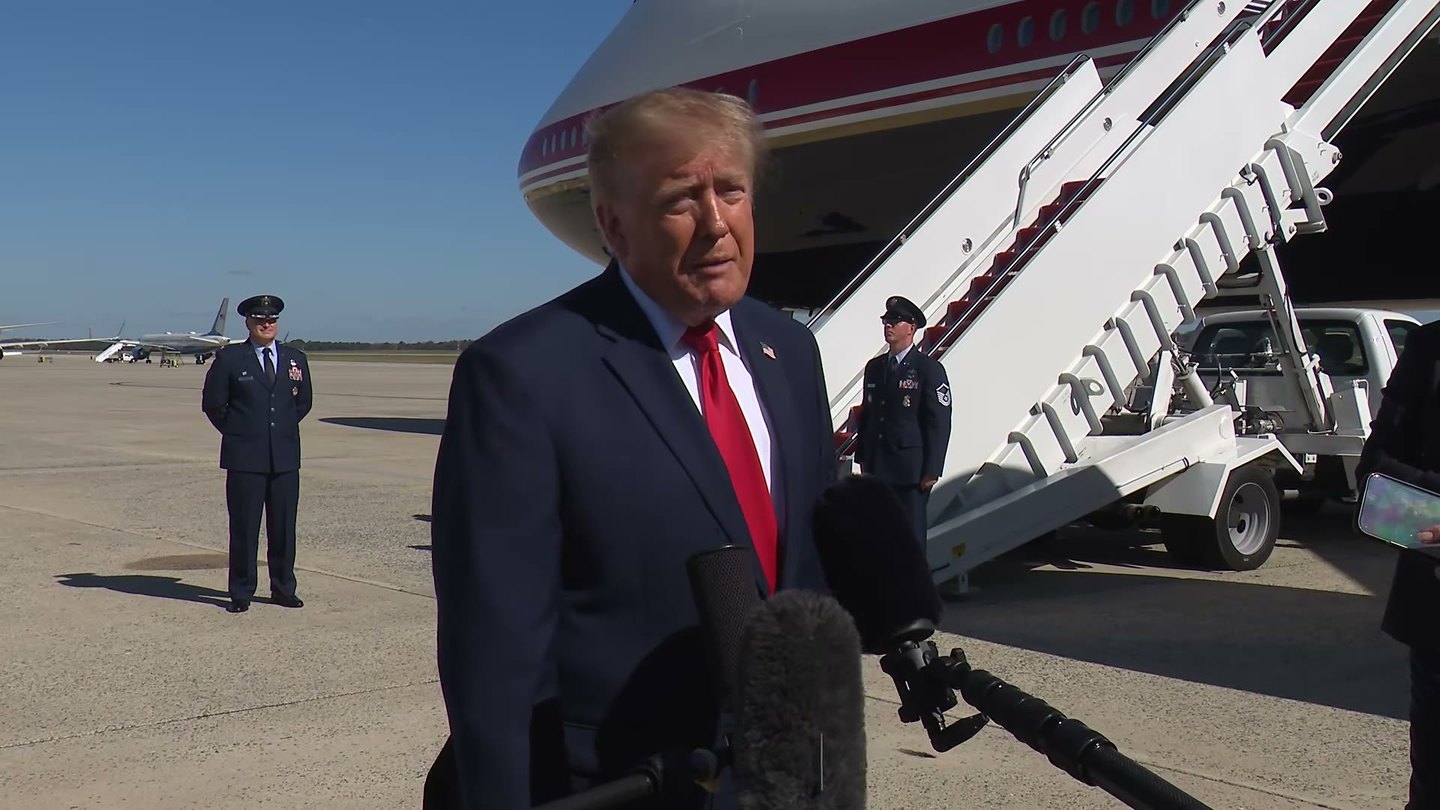
WASHINGTON — President Donald Trump said on Monday that further American military action against Iran will not be necessary “at this point,” after a private White House meeting with the prime minister of Qatar, the country mediating quiet negotiations between Washington and Tehran.
Trump made the remarks in a surprise appearance in the White House briefing room after his meeting with Sheikh Mohammed bin Abdulrahman Al Thani. “At this point, it won’t be necessary, taking the military action,” he said. “Iran, militarily, is effectively over. We’re just keeping it the status quo.”
He kept the military option open in the same breath. “Should there be any change with respect to developments in the Middle East, the United States of America is fully locked and loaded,” he said. “We don’t think there’ll be any reason to use it.”
Two days of the same message
Monday’s remarks extended a line Trump had pressed all weekend. In a 20-minute phone interview with CNN on Sunday, he said five times that it was “highly unlikely” he would need to order the United States back to war with Iran, provided Tehran makes progress towards an agreement on its nuclear programme and on reopening the Strait of Hormuz. “They’re a failing nation,” he said, citing a figure of 301 per cent inflation. “We’ve hit them militarily. We could finish them off.” In the same interview he described American forces in the region — “I’ve got three aircraft carriers here… They’re fully locked and loaded” — and a target list of 38 bridges that could be knocked down, he said, “in literally one hour.”
On CBS’s 60 Minutes he said he was “not looking to” escalate the war, and he did not disagree with Vice President Vance’s assessment that voters “didn’t like the war” — a judgment delivered days after midterm elections in which the war and the cost of living were central issues.
The quiet negotiations
According to CNN, Iran and the United States have quietly been negotiating a sensitive agreement that could avert a return to all-out war and open the door to broader talks. Qatar is mediating between the two sides and circulating a framework document that Washington and Tehran are both amending. The stated subjects are the two that have run through eight months of war and stalemate: Iran’s nuclear programme, and the reopening of the Strait of Hormuz, where tankers have come under Iranian attack.
In his own account of the meeting, posted after it, Trump called the conversation with the Qatari prime minister “excellent” and said Qatar, Saudi Arabia, the United Arab Emirates, Bahrain and Kuwait prefer a continuation of what he called “the Greatest Naval Blockade in History, and the new Operation Iron Gate — Therefore, Land and Sea.” Iran, he wrote, cannot have a nuclear weapon; the United States is “locked and loaded” and ready to act; and there is “positive momentum toward an end to this Conflict.”
The status quo is not silence
The pause Trump described is not a ceasefire, and the shooting has not entirely stopped. The administration has said that strikes it conducted in recent days on Qeshm Island were intended to prevent Iranian surface-to-air missiles from hitting American assets in the region, and American forces continue to escort shipping through the Strait of Hormuz. The war has cost the United States military more than $47 billion as of October 16, according to the Pentagon’s latest estimate.
The politics around it
The war sits at the centre of Washington’s week. On Monday, as Trump spoke, Rep. Thomas Massie filed eight articles of impeachment against Defense Secretary Pete Hegseth centred on the conduct of the war (see the Daily’s report). In Israel, Prime Minister Benjamin Netanyahu’s position is unsettled while his rival Gadi Eisenkot, tapped by the president on Saturday, attempts to form a government. Foreign ministers of the G7, meeting in Paris on Monday, had Iran and Ukraine at the top of their agenda.
Tuesday: Rubio takes the case to the G7
On Tuesday, Secretary of State Marco Rubio told reporters in Paris, after two days of meetings with G7 allies, that the U.S. economic sanctions and naval blockade are working so well that President Trump does not need to conduct major combat operations in Iran, Reuters reported. “The economic pain that is being inflicted on Iran right now is extraordinary and it compounds. It’s growing every day,” Rubio said. “We don’t need to conduct military strikes if we’re achieving the same objective through economic means and economic pressure. That’s not stalemate.” Rubio said Trump had also received input from regional allies in the Middle East confirming the assessment.
Oil markets moved the same way. Brent crude briefly fell below $90 a barrel on Tuesday before settling down 2.1 per cent at $90.61, and U.S. West Texas Intermediate fell 1.9 per cent to $85.18, as traders cut the premium for a wider war, the Wall Street Journal reported.
The Facts
- On Tuesday, Secretary of State Marco Rubio told G7 allies in Paris that sanctions and the naval blockade are working so well that major combat operations are not needed: “That’s not stalemate”
- President Trump met Qatar’s prime minister, Sheikh Mohammed bin Abdulrahman Al Thani, at the White House on Monday, November 9
- After the meeting he said further military action against Iran “won’t be necessary” at this point, and called Iran “militarily, effectively over”
- He said the United States remains “fully locked and loaded” if developments in the Middle East change
- The United States and Iran are quietly negotiating through Qatari mediation; Qatar is circulating a framework document both sides are amending
- The subjects of the talks are Iran’s nuclear programme and the reopening of the Strait of Hormuz
- The war has cost the U.S. military more than $47 billion as of October 16, by the Pentagon’s estimate
Sources: CNN, “US and Iran are quietly negotiating as Middle East remains on edge,” November 9, 2026, and CNN’s report of the president’s Sunday phone interview, November 8, 2026; USA Today, “Military strikes? A peace agreement? Trump opts for status quo in Iran,” November 9, 2026; Associated Press report carried by WDEF News 12, November 9, 2026; the president’s post on his meeting with the Qatari prime minister, November 9, 2026; Reuters, “Rubio says no need for major combat operations on Iran given US economic campaign,” November 10, 2026; Wall Street Journal, “Oil Prices Extend Decline After Trump Signals Restraint On Iran,” November 10, 2026.


Comments